Friday, February 22, 2013

Elkins Melancholy Death of Oyster Boy

http://fictionworms.files.wordpress.com/2011/04/ahern-ps-love-you.jpg?w=640
One poem that really stood out for me was “James.” It is only two lines (short and sweet), and centers around one of the simplest of actions: Santa offering a teddy bear to a little boy named James. However, Burton gave the story a twist and said that James had been “mauled by a grizzly earlier that year,” making this simple good deed of Santa’s an unknowingly cruel one. The picture is even telling, showing a down-on-his-luck boy with a mauled eye (presumably from the bear) being given a toy bear. I can imagine that James is feeling a sense of abandonment as this figure that supposedly cares for all is seemingly mocking his predicament.  The picture reminds me of The Nightmare before Christmas, where a man (or skeleton) wanting to do good for others instead ends up causing a crisis. This may be a stretch, but I can see how James might feel alone in his current state, as a jolly man that supposedly brightens children’s’ lives makes light of his situation.
As for Jung’s archtypes, I do not see how any of them might perfectly apply in this situation. I can, however, see how Santa might be a Wise Man/Sage. It would require looking at the figure of Santa in a different light from the one I cast in the first paragraph, but, if one were to imagine Santa as knowing all (thus knowing about James’s bear attack), then giving James the teddy bear might not be so much a gesture of mocking him so much as a gesture of telling James to “toughen up.” It could be read as a way to tell James (albeit harshly) that life can be tough and that it is best to stare life’s challenges right in the eyes and laugh. Or, it could be that James already tried laughing at and staring a bear in its eyes and was mauled for that reason. The teddy bear could be Santa’s way of saying “bears are not all that bad – like this one, for instance.” Maybe it is something entirely different.  Whatever the case may be, Burton is trying to deliver some sort of profound message (a message that could, in fact, state that not all bears are bad).

Thursday, February 14, 2013

Elkins Mardi Gras

http://bigfishpresentations.com/wp-content/uploads/2013/02/Mardi-Gras-3.jpg
I have lived in Louisiana all my life and was indoctrinated into Mardi Gras at a very young age. However, from what I have heard (I was not able to be in New Orleans during Mardi Gras), there is a huge difference between my experiences and what New Orleans offers – mainly in the degree of what one can get away with, which is what I want to blog about.
            In social psychology, I have learned that when a person is in a group where all are wearing masks (making it difficult to identify one single person), then that person is more prone to behave in a way that he/she would never do under normal circumstances. In Mardi Gras, this effect is very much in play with the practice of masks and parades. Also, there is the fact that Mardi Gras takes place right before the Catholic tradition of Lent (a very restrictive time), so people are much more desperate to get in as much as possible before being made to restrict themselves.
            Do not get me wrong, I enjoy Mardi Gras well enough. I enjoy the sights and the spectacles, but I also think that there is a dark side to it that goes unnoticed a lot of the time. I hear of people fighting for Mardi Gras beads (and of people getting injured from these fights), which normally, people would not really give a second glance (at least, I do not). I know that drunken people do many crazy things with no thought to responsibility, which I know is somewhat part of the fun.
            This somewhat darker side of Mardi Gras is present in many of Tim Burton’s films. For example, in Edward Scissorhands, one person is not enough to confront him, but, when it becomes a bunch of housewives and their husbands, they create enough of a force to drive “the monster” away (showing that one sole person does not have to have all of the blame). In Beetlejuice, Betegeuse uses carnival tactics in order to scare away the Deetses, and to “put on a show.” I am not sure what Burton is trying to say in these scenes, but I have a feeling that he is critical of how the normal person celebrates in the Carnival atmosphere.    

Wednesday, February 6, 2013

Elkins Edward Scissorhands

Fairy tales are no strangers to using violence in their stories to teach a moral. However, more often than not, they usually take place in some far-away place. This is not the case with Edward Scissorhands, which makes the violence in fairy tales all too real.
Edward Scissorhands is not your typical fairy tale. In fact, the only real things it takes from a run of the mill fairy tale are a mysterious castle (which blends kind of awkwardly with the suburban setting of the rest of the movie), a book-end type of framing, and a so-called “monster” that no one really understands. Edward’s creation is pulled straight out of the confines of a fairy tale world – he is in the middle of human and creature, and no one really knows how to react to him.
Edward, as the story progresses, gets taken in by a more or less friendly family and, by the end of it, becomes known to be a murderous monster by the suburban families (except for the family that takes him in). What goes on in between those two events is a commentary on human morality – and how it is shown in a more modern setting. The movie asks the question of “Where did all the good people go?” It is a question that most people will likely point to themselves in answer. I, however, think that the “good people” asked about never existed simply because people cannot be categorized as either good or bad.
While I would not say that the suburban townspeople are evil and want anything that is different to go away and die, they do have normal human faults. They use Edward for his creativity and his scissor hands, but, as soon as they are given reason to believe he is a monster through and through, they forget what he has done for them and shun him for the supposed “monster” that he is made out to be.
I think Burton has shown us a unique new perspective on the fairy tale that is fairly ironic. Burton manages to make the typical monster that has nothing but hate for those it terrorizes (seen in countless fairy tales) the townspeople, and he manages to make the innocent thing being terrorized the so-called “monster” – Edward Scissorhands.

Thursday, January 31, 2013

Elkins Batman Returns

http://images2.fanpop.com/image/photos/8900000/Michelle-Pfeiffer-catwoman-selina-kyle-8971857-446-480.jpg

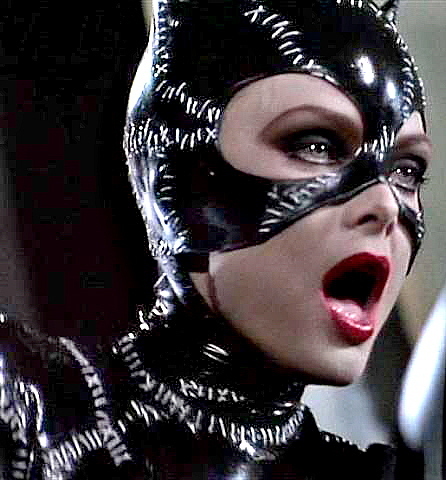
Catwoman has always been a staple of the Batman universe that no one really knows quite what she is. In all of her incarnations, really only two things remain with her: her normal, tamer side is Selina Kyle, and she changes (usually at night) into Catwoman – her more destructive side. I think Burton was able to capture this well in Batman Returns. She more than makes up for the boring, uninteresting character of Vicki Vale in Batman, and she provides a new wheel for the plot in the movie to continue, using Selina Kyle and Catwoman as more or less two different characters in the same body (like Bruce Wayne/Batman).
“We’re like two sides of the same thing, cut down the middle.” Batman tells Catwoman something along the lines of this quote in the scene where he reveals for a second time to Catwoman who he is. This quote also sums up Batman and Catwoman’s relationship in a very concise way. One side of both of them (“the Masked Side”) is forever in conflict with the other, and the other side of both of them is always tame and cordial to the other (“the Normal Side”). Neither one really knows exactly what the other has up his or her sleeve. It truly is one of the most complicated relationships I have ever seen on screen.
With Bruce Wayne, Selina Kyle is cordial and follows social norms. They both seem very superficial to one another, and I cannot imagine that the plot of the movie would go anywhere if it were just these two normal people talking to each other the entire time. It only really gets interesting when the audience starts to see the other side leak through both them.
With Batman, Catwoman is a tricky beast that some could argue is more feline than human. All of their interactions with each other are pretty much comic-book fights. She uses seduction on him, and Batman never really seems to be able to predict what she is going to do next (and he is the World’s Greatest Detective). A perfect example of this is the last scene, right before she kills Max Schrek (after Bruce Wayne invites her to live in his Manor, which she denies only after leading him on a bit).
The Catwoman/Selina Kyle and Batman/Bruce Wayne relationship is incredibly complicated and Burton achieves something that he has always said: no one is only one thing.

Thursday, January 24, 2013

Elkins Batman

http://www.confusedmatthew.com/Batman-Films.php


Being a huge Batman fan, I have been looking forward to this watching this movie since day one. It has been a while since I have seen it, so I was pretty excited to watch it. With that in mind, I enjoyed it overall, but the inner Batman fan in me was annoyed by some of the changes (Joker’s origin story, Batman killing, the whole killing of Bruce’s parents). But that is not the point of this post, though I could complain a fair amount about the film (do not get me wrong, though – I enjoyed it). I want to talk about the Joker.
Created by Bill Finger and Bob Kane, the Joker has always been Batman’s nemesis and has always wanted to create as much trouble as possible simply for the hell of it. He is a trickster character, and like every good trickster character, he pushes the limits of power. I think Burton made it very clear as to what kind of trickster Joker is, from destroying paintings to killing mass people (which I think undermines the idea of a trickster in a way, but I will get to that later). From the Joker using witty one-liners to contaminating Gotham’s cosmetic products, Burton definitely supports the idea of a trickster with the Joker’s witty, somewhat playful destruction – all with a smile on his face.
However, I also think that Burton undermines the idea of a trickster in two key ways. The Joker has no special powers, and does not outwit people as much as just kills them. The Joker is someone who could potentially fit into our own world, so magic is out of the question. The Joker uses guns when he can, and kills people in whatever way he sees fit. Like the art museum scene (with Vicki Vale) and the very end, Joker does not seem to care who he kills, as long as it is creative (“I’m the world’s first fully-functional homicidal artist").
The Joker in Batman makes a very dark, very convincing trickster that fits well in this movie. He is a homicidal maniac, and one never knows what he will do next, which I think was Burton’s intention.

Wednesday, January 16, 2013

Elkins Beetlejuice

            Death is a fact of life that is inevitable. There’s a 100% failure rate in people that have tried to live forever. No matter how important or rich a person is, death makes us all equal in the end. America refuses to believe this.
            What with such popular trends in the media telling us to “live while we can” and new advances in medicine allowing us to live just a little bit longer, Americans, it would seem, cannot and will not grasp the concept that at some point they will depart from this life here on Earth. Death, I think most can agree, is a concept that most do not want to hasten. Why think about dying when one can think about living forever? Hollywood films, like Beetlejuice (especially Beetlejuice), would rather people laugh at death, which most are more than willing to do.
            Beetlejuice, a story of ghosts and the after-life, would appear at first to be a movie about accepting death as just another phase of life, and that death is not the end-all-be-all that people believe. Yet, I believe it does not accept death at all. It wants to sugar-coat it and say that people will just come back as ghosts, and it will be the same as life – waiting rooms and all. Take the Maitlands, for instance. They had no idea they were dead until they started experiencing weird things and found the manual called Handbook for the Recently Deceased. Their only conflict throughout the movie was scaring the Deetse’s out of the house so that they could continue living in it and work on the model city. Even at the end of the film they are helping Lydia with her school work and continuing to live their lives as before.
I do not know if Burton did this intentionally or not, but in one scene Mrs. Maitland tries to scare Mrs. Deetse by in a closet by tearing off her own face. Mrs. Deetse bats her out of the way, a symbolic moment of how the Deetse’s do not think about death.
In Beetlejuice, Tim Burton makes one thing clear: death, in all its forms, is something Americans want to ignore.

http://www.fanpop.com/clubs/beetlejuice-the-movie/images/23838576/title/beetlejuice-screencap

Tuesday, January 8, 2013

Elkins Introduction


My name is Charles Elkins. I am from Plaquemine, Louisiana (near Baton Rouge). I am presently a psychology major. I chose this Tim Burton Seminar because I enjoy some of his movies. I enjoy reading and watching movies, as well as playing a few video-games.  I also enjoy humor quite a bit and do not like to take anything too seriously (and by too seriously, I mean over-the-top).
I am a Freshman at Loyola University New Orleans, which is kind of obvious since I am in this class.  I am a frequent redditor (although I do not like to get sucked in like a few people), and dislike using Facebook. I enjoy history, with my favorite subject area being the Italian Renaissance (although, that changes from time to time). I dislike being under pressure, so I get things done rather early. I also enjoy English.
I am very awkward in social situations, which is one reason as to why I am a psychology major. I like to delve into the human brain and see what makes us work. Currently, I am taking social and abnormal psychology, both of which really fascinate me. I find it interesting that humans want to learn more about the world in which they live in, yet barely understand themselves. I want to understand why people are the way they are.
I am a huge nerd. I like Game of Thrones (currently on Storm of Swords in the books), Harry Potter, Doctor Who, etc. I could go on. My family (I have a brother and a sister) enjoy taunting me with said nerdiness, which I am perfectly fine with them doing. I am a  big Batman fan (although, I have not seen Tim Burton’s take on him in quite a while, so this seminar should be good for that).
I enjoy travelling. Usually, my family and I go to a foreign location during the summertime (my favorite has been England, where I plan to study abroad in the near future). I like to learn about different cultures and languages in the places where I travel. I also enjoy koalas quite a bit.